
For researchers developing T-cell engagers, one of the biggest unanswered questions is surprisingly simple: how to quantify productive connections are actually formed between T cells and tumor cells?
This interaction is at the heart of T-cell engager biology, influencing potency, safety, and the kinetics of the immune response.
That's why LUMICKS is collaborating with Amgen to quantitatively measure Cell Avidity, a direct readout of T cell–tumor cell binding strength. The long-term vision is to better understand how cellular engagement relates to immune synapse formation and incorporate these insights into Quantitative Systems Pharmacology (QSP) models to support future molecule design, translation, and development.
The first step is understanding how affinity shapes cellular binding.
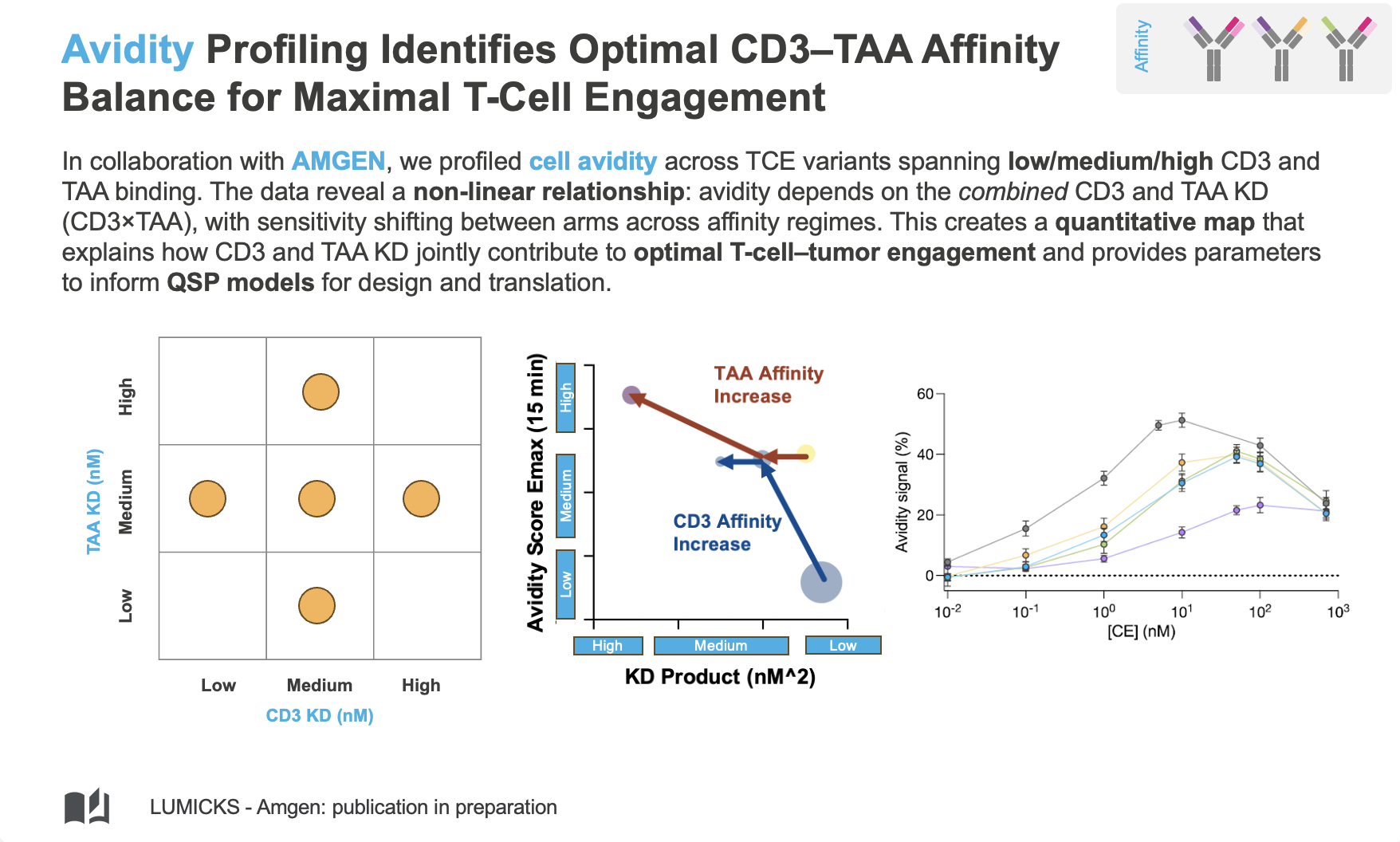
Using five T-cell engager variants with different combinations of CD3 and tumor-target (TAA) affinities, we observed a clear trend:
- Increasing CD3 affinity improves T cell–target binding, but only up to a point.
- Stronger TAA affinity provides the additional boost needed to reach the highest avidity levels.
- The strongest cellular engagement is achieved through the right balance between the CD3 and TAA arms, rather than maximizing either arm alone.
These findings suggest that affinity does not translate linearly into cellular engagement. Instead, avidity captures how both binding arms work together to drive productive T cell–tumor interactions.
This is only the beginning. The next piece of the story is already in hand: combining avidity measurements with functional outcomes, providing additional validation of how well Cell Avidity predicts biological activity.
At #PEGSEurope 2026, we will reveal the next set of results from the Amgen-LUMICKS collaboration, showcasing how avidity measurements connect molecular design to biological outcomes.
Understand how to profile T-cell engager with Cell Avidity? Be among the first to see the next Amgen-LUMICKS dataset at PEGS? Or simply download the 1-slide? Contact LUMICKS

.jpg)

